Tennis Elbow: Why Your Elbow Hurts and How Osteopathy May Help
Written by Maëva Loyson

You don't have to play tennis to develop tennis elbow.
That aching feeling on the outside of your elbow can show up after gardening, lifting, typing, working with tools, carrying a child, playing an instrument, exercising, or spending hours doing repetitive hand and wrist movements.
Sometimes it starts as a small discomfort that you barely notice.
Then one day, opening a jar hurts. Picking up a cup feels uncomfortable. Shaking someone's hand becomes painful. Even gripping your phone can remind you that something is not quite right.
This is commonly known as tennis elbow, or more accurately, lateral elbow tendinopathy.
At Hello Osteo, we look beyond the painful spot. Understanding how your elbow, wrist, shoulder, neck, and the rest of your body work together can be an important part of understanding persistent elbow pain.
What Is Tennis Elbow?
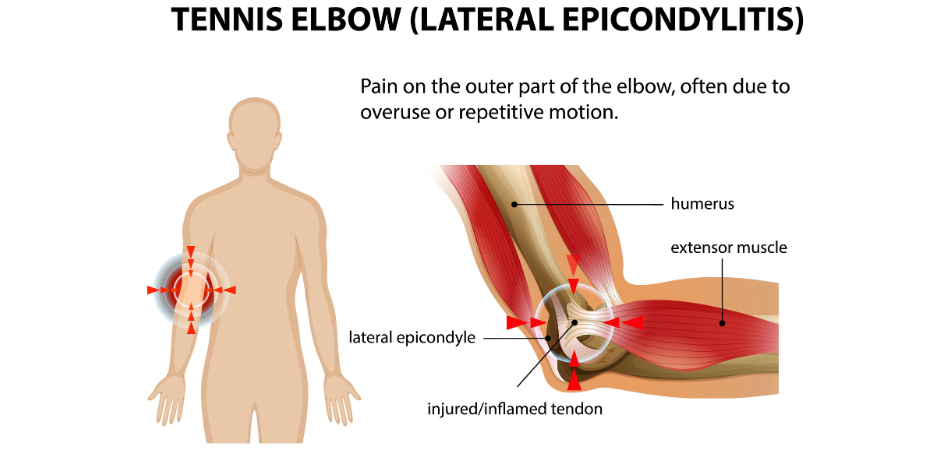
Tennis elbow is a condition involving the tendons on the outside of the elbow.
These tendons connect muscles of the forearm to the bones around the elbow and help control movements of the wrist and hand.
Despite the name, tennis players account for only a small proportion of cases. Lateral elbow tendinopathy can affect anyone whose activities repeatedly load the forearm and wrist.
The problem is often associated with repeated or increased loading of the tendon, particularly when the amount of activity increases faster than the tissues can comfortably adapt.
It is not simply a case of having a "weak" elbow.
What Does Tennis Elbow Feel Like?
The most common symptom is pain or tenderness around the outside of the elbow.
You may also notice:
- Pain when gripping an object
- Discomfort when lifting something
- Pain when turning a door handle or opening a jar
- Pain when moving your wrist
- Aching that travels down the forearm
- Reduced grip strength
- Tenderness around the outside of the elbow
- Stiffness, particularly after periods of inactivity
For some people, the discomfort is mild and appears only during certain activities.
For others, it can gradually become more persistent and start interfering with work, sport, sleep, or everyday tasks.
Why Does Tennis Elbow Happen?
Tendons are designed to handle load.
The problem can occur when a tendon is repeatedly exposed to more load than it is currently prepared to manage.
This might happen after:
- Starting a new sport
- Increasing training suddenly
- Returning to exercise after a break
- Repetitive computer or hand work
- Gardening or DIY
- Manual work
- Repeated lifting or carrying
- Racket sports
- Activities involving frequent gripping or twisting
Sometimes there is no single moment when the pain began.
Instead, the symptoms gradually build over time.
This is why it can be useful to look at what your arm has been doing over the days or weeks before the pain appeared, rather than focusing only on one movement.
It Is Not Always About the Elbow
Your elbow does not work alone.
Every time you grip, lift, type, throw, carry, or reach, your hand, wrist, forearm, elbow, shoulder, and upper back are working together.
For this reason, an assessment may consider more than the painful area.
An osteopath may look at:
- How your wrist and forearm move
- Grip and loading patterns
- Elbow mobility
- Shoulder movement
- Neck and upper-back mobility
- Muscle tension throughout the arm
- How you perform the activities that aggravate your symptoms
This does not mean that a problem in your neck or shoulder is necessarily causing your tennis elbow.
It simply means that understanding the whole movement pattern can help create a more individualized approach.
What Can You Do When Your Elbow Starts Hurting?
The first step does not necessarily have to be complete rest.
In many cases, it is more useful to modify the activities that are aggravating the tendon while gradually rebuilding its capacity.
1. Reduce the Irritating Activity
If a particular movement consistently increases your pain, try reducing the frequency, duration, or intensity for a while.
You may not need to stop everything.
Changing how you perform an activity can sometimes be enough to reduce the load on the tendon.
2. Keep Moving
Complete immobilization is not usually the goal.
Gentle movement can help prevent stiffness, while gradually increasing the amount of load your arm can tolerate can support recovery.
3. Gradually Strengthen the Forearm
Progressive strengthening is an important part of rehabilitation for lateral elbow tendinopathy.
Exercises may include isometric, concentric, or eccentric loading of the wrist and forearm muscles, depending on the stage of recovery and your individual symptoms.
The goal is not to push through severe pain. It is to gradually teach the tendon to tolerate more load again.
4. Look at How You Grip
Sometimes we use much more force than necessary.
When lifting, carrying, or using tools, consider whether you can reduce unnecessary gripping force or change your hand position.
Small changes can reduce repeated stress on the forearm.
5. Give Your Body Time
Tendons can take time to adapt.
Tennis elbow often improves gradually rather than overnight, and symptoms may fluctuate during recovery.
That does not necessarily mean that you are getting worse.
How Can Osteopathy Fit Into Tennis Elbow Care?
Osteopathy can be used as part of a broader approach to managing musculoskeletal pain.
At Hello Osteo, treatment would not simply focus on pressing or working directly on the painful elbow.
Your osteopath may assess how the elbow, wrist, forearm, shoulder, neck, and upper back are moving and how they contribute to the activities that are provoking your symptoms.
Depending on your individual presentation, treatment may include gentle manual techniques aimed at improving comfortable movement and reducing muscular tension.
Manual therapy has shown some short-term benefits for pain and function in people with lateral elbow pain, although the evidence is mixed and the longer-term benefits are less certain. This is why hands-on treatment is best considered alongside active rehabilitation rather than as a stand-alone solution.
Osteopathy and Exercise Can Work Together
One of the most important things to understand about tennis elbow is that treatment is not simply about making the pain disappear.
Your tendon also needs to gradually regain its ability to tolerate the activities you want to return to.
This is where an individualized combination of:
- Activity modification
- Progressive strengthening
- Movement education
- Hands-on care when appropriate
- Gradual return to sport or work
Can be useful.
The exact approach depends on your symptoms, your lifestyle, and what you need your arm to be able to do.
When Should You Get Your Elbow Checked?
Not every case of outer elbow pain is tennis elbow.
Other conditions can cause pain around the elbow, and persistent symptoms may need a proper assessment.
Consider seeing a healthcare professional if:
- Your pain is getting worse
- You have significant swelling
- Your elbow becomes very stiff
- You experience numbness or tingling
- You notice significant weakness
- Your pain began after a significant injury
- You cannot comfortably use your arm
- Your symptoms are not improving despite modifying activities
A proper assessment can help determine whether lateral elbow tendinopathy is actually the most likely explanation for your symptoms.
Your Elbow Does Not Have to Be Your Limitation
Tennis elbow can be frustrating because the movements that trigger it are often part of everyday life.
You still need to work.
You still need to cook, carry things, exercise, type, garden, play, and live.
The goal is not simply to protect your elbow forever.
It is to understand what is irritating it, adjust the load when necessary, and gradually build your capacity again.
At Hello Osteo, we take a whole-body approach to musculoskeletal care. We look at the way you move, the activities you need to return to, and how your body is adapting to those demands.
If your elbow has been telling you to slow down, it may be time to listen.
Book at Our Kingston or Amherstview Clinic
References
- National Health Service. Tennis elbow. NHS.
- Berkshire Healthcare NHS Foundation Trust. Physiotherapy advice for lateral elbow tendinopathy. 2026.
- Karjalainen TV, et al. Manual therapy and exercise for lateral elbow pain. Cochrane Database of Systematic Reviews. 2024.
- Hanley MA, et al. Do joint mobilizations assist in the recovery of lateral elbow tendinopathy? A systematic review and metaanalysis. Journal of Hand Therapy. 2018.
Ready to take the next step?
Our osteopathic treatments are tailored to your body and goals.
Learn more about our services ->