Infant Mobility: What to Expect at 1 Month Old
Written by Maëva Loyson

Bringing your newborn home is an exciting and sometimes overwhelming experience. Suddenly, every little stretch, twitch, head movement, and change in position can make you wonder:
Is this normal? Should my baby be doing more?
At just 1 month old, your baby is not expected to be rolling, sitting, or reaching for toys yet. But that does not mean nothing is happening.
In fact, your baby's body is already doing a lot of important work. They are gradually getting used to life outside the womb, learning how to move against gravity, developing early neck strength, and beginning to gain more control over their little body.
Here is what you can expect from your 1-month-old's movement and physical development, how to make tummy time easier, and how gentle osteopathic care may support your baby's comfort and movement.
Normal Movements at 1 Month
At around 4 weeks old, many of your baby's movements are still controlled by natural newborn reflexes. Their movements may look jerky, wiggly, or uncoordinated, and that is completely normal.
Your baby is still adjusting to having more space to move than they had in the womb.
What You May Notice
- A curled-up posture: Your baby may still look very much like they did before birth, with their arms and legs bent and tucked close to their body. Their little hands may also spend a lot of time in tiny fists.
- Lots of spontaneous movement: You may see sudden kicks, arm movements, stretches, or little jerks. At this stage, your baby is not fully controlling these movements yet.
- The startle reflex: Loud sounds or sudden movements may cause your baby to throw their arms out and then pull them back in. This is known as the Moro, or startle, reflex.
- Early head movement: During supervised tummy time, your baby may briefly lift or turn their head. Their neck muscles are still very young and developing, so even a small head lift is a great start.
- Looking to both sides: Your baby will gradually explore turning their head to the left and right.
Every baby develops at their own pace, so there is no need to compare your little one too closely with another baby. At this age, it is more about watching their overall comfort and movement than expecting them to reach a particular skill on a specific day.
Tummy Time: A Little Practice Goes a Long Way
You may have heard the phrase:
Back to sleep, tummy to play.
When your baby is awake and closely supervised, tummy time is a wonderful opportunity for them to explore movement and begin building strength.
Tummy time helps your baby practise lifting and turning their head while strengthening the muscles they will later use for rolling, sitting, crawling, and other exciting milestones.
Why Tummy Time Matters
It helps build strength
Each little attempt to lift or turn the head helps your baby begin strengthening their neck, shoulders, back, and upper body.
It gives the back of the head a break
Babies spend a lot of time sleeping on their backs, which is the safest sleep position. Supervised tummy time during the day helps reduce the amount of time spent with pressure on the same area of the head.
It gives your baby a new way to explore
Tummy time lets your baby experience the world from a completely different position. Your face, voice, toys, and surroundings can all encourage them to look around and move.
How to Do Tummy Time With a 1-Month-Old
If your baby does not enjoy tummy time yet, do not worry. Many babies protest at first.
The good news is that tummy time does not have to mean placing your baby on a mat and hoping they enjoy it.
Try a few different positions and see what feels best for your little one.
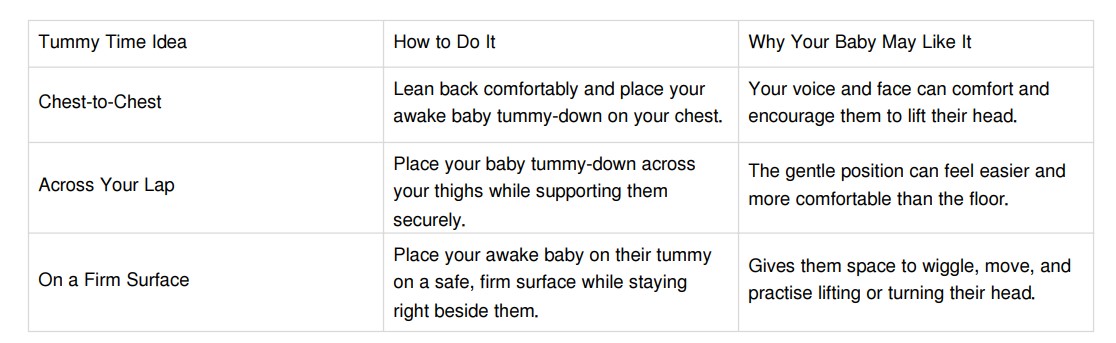

Start small. Even a minute or two can be enough when your baby is just beginning.
You can try several short sessions throughout the day rather than one long session.
And remember, tummy time does not need to be perfect. If your baby gets upset, simply pick them up, comfort them, and try again later.
What if My Baby Always Looks to One Side?
It is common for babies to have little preferences. You may notice that your baby enjoys looking toward the window, turning toward your voice, or sleeping with their head facing a particular direction.
However, if you begin to notice that your baby almost always looks to one side or seems uncomfortable turning the other way, it may be worth paying attention to.
Other things you may notice include:
- Your baby strongly prefers looking in one direction.
- They seem to have difficulty turning their head to the other side.
- One side of the back of their head is beginning to look flatter.
- They seem uncomfortable in certain positions.
- Feeding feels easier on one side than the other.
These patterns do not automatically mean that something is wrong, but it can be helpful to speak with your baby's pediatrician or another qualified healthcare professional.
Sometimes babies can develop tightness in the neck muscles, including a condition called torticollis, which can make turning in one direction more difficult.
The earlier a persistent preference is noticed, the easier it can be to understand what is happening and support your baby's movement.
How Gentle Pediatric Osteopathy May Help
Babies experience a lot during pregnancy and birth.
Some spend weeks or months curled into one position in the womb. Others may experience a long labour, a very quick birth, or an assisted delivery.
Every baby's experience is different.
During a pediatric osteopathic appointment, the practitioner gently observes how your baby moves, rests, turns their head, and responds to different positions.
The approach is very gentle and designed specifically for infants.
An Osteopathic Assessment May Look At:
- How easily your baby turns their head to both sides.
- Whether they seem to have a favourite side.
- How freely their body moves during everyday handling.
- Their overall posture and movement patterns.
- Areas where they may appear uncomfortable or restricted.
Depending on the individual baby, gentle hands-on techniques and advice about positioning, handling, and movement may be used to support comfort and ease of movement.
Osteopathic care can be a supportive part of your baby's overall care. If there are concerns about torticollis, feeding difficulties, changes in head shape, or other developmental concerns, it is important to also speak with your baby's pediatrician or healthcare provider.
Simple Ways to Support Your Baby at Home
You do not need special equipment or complicated exercises to encourage your baby's movement.
Often, the little things you do throughout the day can make a big difference.

1. Change Sides During Daily Care
Try alternating the arm you use when holding your baby or the direction from which you approach them.
This can naturally encourage them to look and turn in different directions.
2. Let Your Baby Follow Your Face and Voice
At this age, your baby loves looking at faces.
During playtime or tummy time, gently move from one side to the other and talk to your baby. They may begin to follow your voice or face with their eyes and head.
3. Keep Tummy Time Short and Regular
A few little sessions throughout the day can be easier than trying to make your baby stay on their tummy for a long time. Think of it as practice, not a test.
4. Give Your Baby Opportunities to Move Freely
When your baby is not travelling, try to give them time outside of car seats, swings, and other baby containers.
Being held, lying on a safe surface, and enjoying supervised tummy time all give your baby opportunities to stretch, wiggle, and explore movement.

Every Little Movement Matters
At 1 month old, your baby's world is still very new.
They are learning how their body feels outside the womb. They are gradually building strength, discovering movement, and getting ready for all the wonderful milestones ahead.
Right now, there is no need to rush.
A brief head lift, a little turn toward your voice, a stretch of the legs, or a few moments of tummy time are all small parts of a much bigger developmental journey.
If you have noticed that your baby strongly prefers one side, seems uncomfortable turning their head, or you simply have questions about their movement and positioning, a gentle assessment can help you better understand what your little one needs.
At Hello Osteo, we take a gentle, caring approach to infant osteopathic care. We look at your baby as an individual and work with you to support their comfort, movement, and early development.
Book an infant osteopathic assessment with Hello Osteo today and give your little one a gentle start to their journey of movement and growth.
References
- American Academy of Pediatrics. Safe Sleep and Tummy Time Recommendations.
- Centers for Disease Control and Prevention. Developmental Milestones.
- American Academy of Pediatrics. Prevention and Management of Positional Skull Deformities.
- HealthyChildren.org. Positional Skull Deformities and Torticollis.
Ready to take the next step?
Our osteopathic treatments are tailored to your body and goals.
Learn more about our services ->